
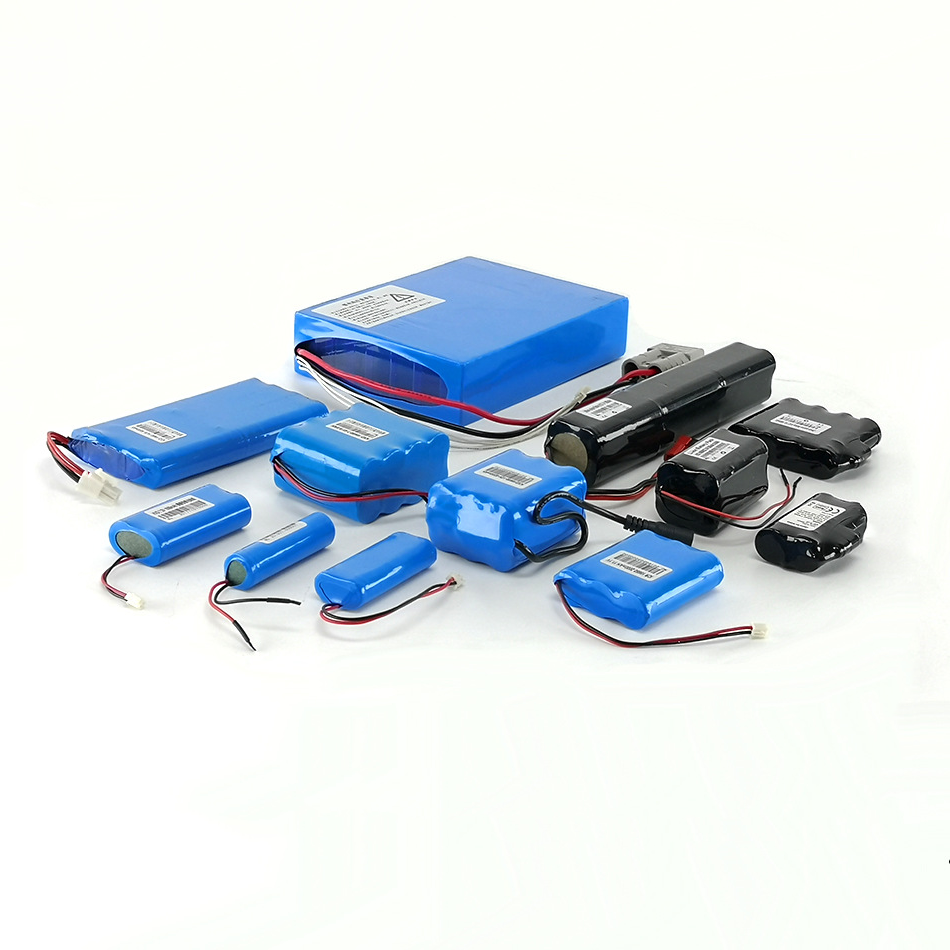
This guide provides a comprehensive overview of connecting lithium battery cells to form battery packs, covering definitions, assembly processes, important considerations, and charging methods. Customized battery pack Battery customization service
BECELL is dedicated to customizing various types of battery pack products for clients, offering comprehensive services that include design, prototyping, and mass production for all kinds of battery pack solutions.
01 Definitions of Series and Parallel Connections
Individual battery cells have limited voltage and capacity. To meet the voltage and capacity requirements of various devices, cells are connected in series and parallel combinations.
- Series Connection: Increases voltage, while capacity remains the same. Internal resistance increases.
- Parallel Connection: Increases capacity, while voltage remains the same. Internal resistance decreases, extending runtime.
- Series-Parallel Connection: A combination of both series and parallel connections to achieve higher voltage and capacity.
- Series Voltage: Using 3.7V cells, a battery pack’s voltage is 3.7V multiplied by the number of cells in series (N), e.g., 7.4V, 12V, 24V, 36V, 48V, 60V, 72V.
- Parallel Capacity: Using 2000mAh cells, a battery pack’s capacity is 2Ah multiplied by the number of cells in parallel (N), e.g., 4000mAh, 6000mAh, 8000mAh, 5Ah, 10Ah, 20Ah, 30Ah, 50Ah, 100Ah.
02 Lithium Battery PACK
Lithium Battery PACK refers to the process of assembling and packaging lithium cells into a finished battery pack. This can be a single cell or a complex series/parallel pack. A typical PACK consists of:
- Lithium Cell: The core component storing energy.
- Protection Circuit Board (PCB/BMS): Provides intelligent protection against overcharge, over-discharge, overcurrent, short circuits, and often includes temperature control (NTC).
- Plastic Casing: Provides structural support, positions and secures the protection board, and houses all components.
- Terminal Leads/Wires: Provides the charge/discharge interface with various connectors for different applications (electronics, energy storage, backup power).
- Nickel Strips / Brackets: Used for connecting cells and fixing them in place.
03 Series and Parallel Combinations
Due to safety concerns, lithium batteries must be used with a protection board to monitor each cell. Parallel connection is generally not recommended unless cells are perfectly matched. Cells used in series must also have consistent parameters; otherwise, the pack’s performance will be significantly worse than individual cells.
❌ Incorrect Parallel: Cells with different capacities.
❌ Incorrect Parallel: No protection board used.
❌ Incorrect Series: Cells with different capacities.
❌ Incorrect Series: No protection board used.
Cell Matching Criteria:
For optimal performance and safety, cells must be closely matched before assembly:
- Voltage Difference: ≤ 10mV
- Internal Resistance Difference: ≤ 5mΩ
- Capacity Difference: ≤ 50mAh
Mismatched cells lead to voltage imbalances over time, causing some cells to be overcharged or over-discharged, reducing overall capacity, and creating a risk of fire or explosion.
Common Lithium Battery Combinations:
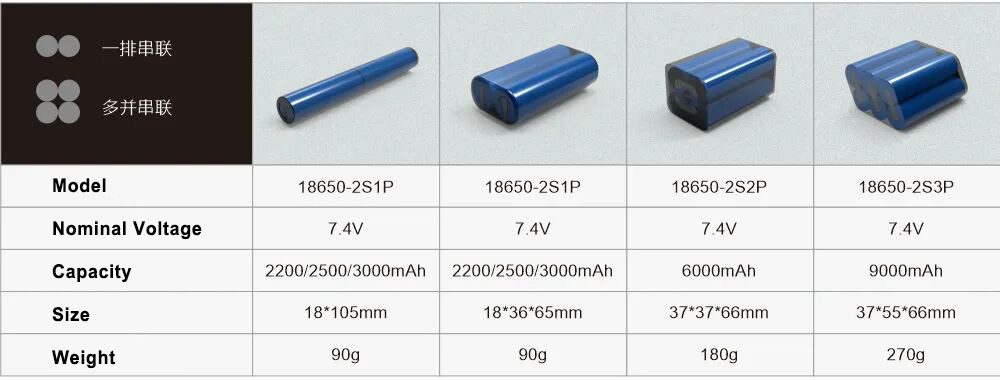
- 2-Series (2S): 7.4V Battery
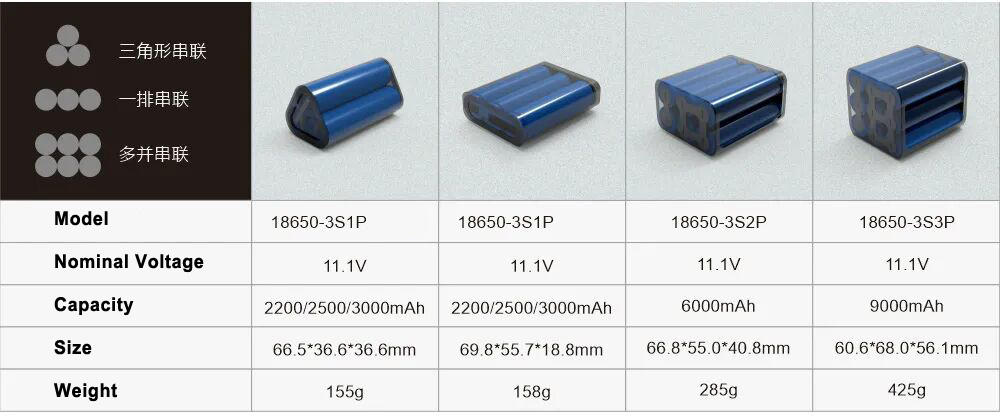
- 3-Series (3S): 11.1V Battery
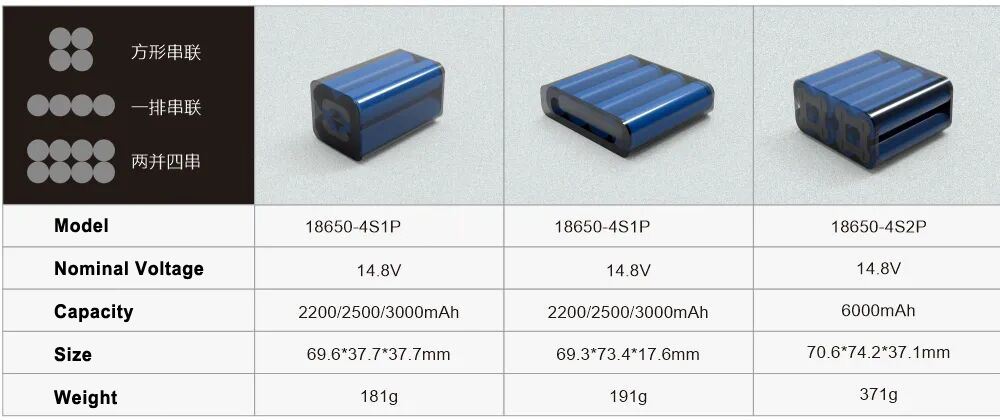
- 4-Series (4S): 14.8V Battery
- 6-Series (6S): 22.2V Battery
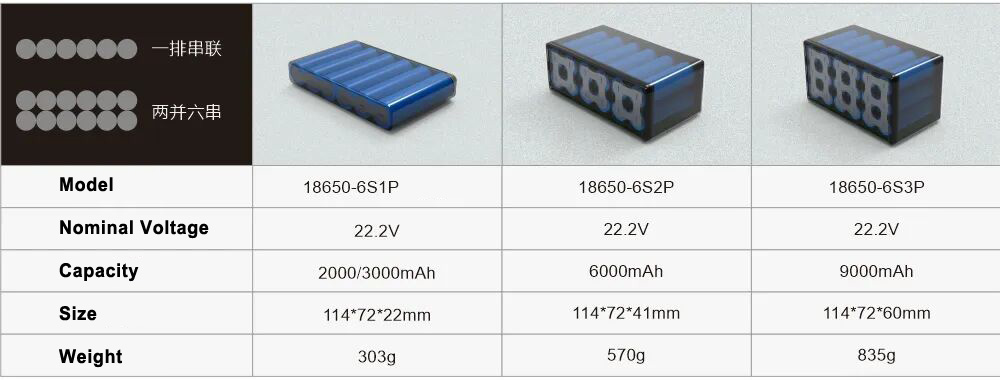
Common Lithium Battery Pack Series Combinations
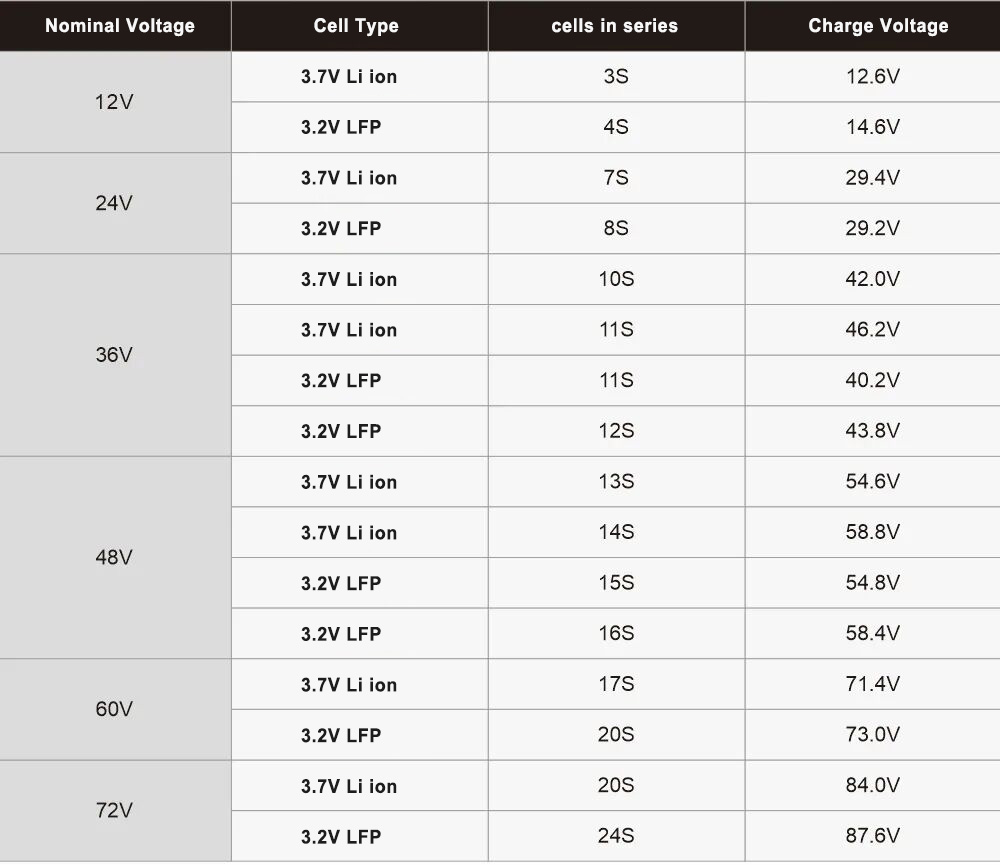
Series-Parallel Calculation Example (48V 20Ah Pack):
- Assumed Cell Specification: 18650, 3.7V, 2000mAh
- Cells in Series (for 48V nominal): 48V / 3.7V ≈ 13 cells in series (13S)
- Cells in Parallel (for 20Ah capacity): 20Ah / 2Ah = 10 cells in parallel (10P)
- Total Cells: 13S * 10P = 130 cells
04 Lithium Battery Assembly Process (Example: 18650 3S6P / 11.1V / 15600mAh)
- Cell Grading (Sorting by Capacity): Ensure capacity difference ≤ 30mAh. Cells are often rested for 48-72 hours after grading before matching.
- Voltage & Internal Resistance Matching: Group cells with similar voltage (≤5mV difference) and internal resistance (≤5mΩ difference).
- Cell Spot Welding: Use formed nickel strips to connect cells, avoiding poor welds, shorts, and current distribution issues.
- Soldering the Protection Board (BMS): Verify no missing or poorly soldered components on the BMS.
- Battery Insulation: Apply insulating paper (e.g., fish paper) and tape (e.g., Mylar tape) to prevent short circuits.
- Battery Pack Aging Test: A critical step to verify the pack’s stability, safety, and lifespan by simulating charge/discharge cycles.
- PVC Heat Shrink Wrapping: Apply PVC film evenly, shrinking ends first, then the middle. Ensure no bubbles, wrinkles, or holes.
- Final Performance Testing & Inkjet Marking: Test final performance and print clear, non-slanted markings (voltage, capacity, date, etc.) on the pack.
05 Important Precautions for Series/Parallel Connections
- Do not mix different brands of batteries.
- Do not mix batteries with different voltages.
- Do not mix batteries with different capacities or old with new batteries.
- Do not mix different chemistries (e.g., NiMH and Lithium).
- Replace all batteries in a pack when they are low/depleted.
- Always use a protection board (BMS) rated for the specific configuration.
- Strictly match cells according to the criteria (voltage, IR, capacity) mentioned in Section 03.
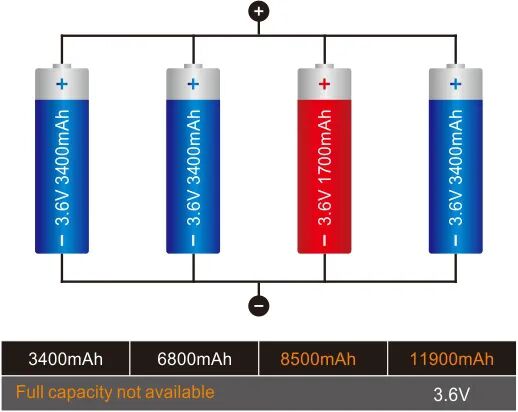
- Different Voltages in Series: Connecting cells with different voltages in series causes the lowest voltage cell to limit the pack’s capacity and become prone to over-discharge/over-charge damage.

- Different Capacities in Parallel: Connecting cells with different capacities in parallel leads to uneven charge/discharge, potentially causing overcharge of smaller cells, over-discharge of others, leading to leakage or cell failure (zero voltage).
06 Assembly Topology: Parallel First or Series First?
There are two primary ways to structure a large battery pack, with trade-offs:
- Parallel-First (Preferred for many applications like EV buses): Cells are connected in parallel to form modules, then these modules are connected in series.
- Advantages: If one cell fails (opens), the parallel group can still function with reduced capacity. Fuses can protect against cell shorts.
- Disadvantages: Minor differences in cell internal resistance or heat dissipation within the parallel group can affect the overall cycle life.
- Series-First (Often used in grid storage): Cells are connected in series to form higher voltage strings, then these strings are connected in parallel.
- Advantages: Can reduce the failure probability for very large capacity packs. Can be beneficial for cell balancing and management.
- General Conclusion: For reliability and managing voltage inconsistency, the parallel-first topology is often considered superior to series-first, though series-first can simplify individual cell monitoring.
07 Charging Series-Parallel
- 1. Charging in Series:
- This is the most common method due to its simplicity and low cost.
- Challenge: Due to small differences between cells, the cell with the smallest capacity will reach full charge first. If charging continues, this cell will be overcharged, which is dangerous.
- Solution: A Battery Management System (BMS) is essential. It monitors each cell’s voltage and cuts off charging when any single cell reaches its overcharge protection voltage, preventing overcharge but potentially leaving other cells slightly undercharged.
- 2. Charging in Parallel:
- Cells in parallel essentially act as a larger cell. They should be charged together.
- Key Considerations:
- Do not mix packs with and without internal protection boards when charging in parallel.
- Packs designed for parallel charging usually use a single, common BMS for the entire parallel group.
- If charging a parallel pack without a BMS, the charger voltage must be strictly limited to the cell’s maximum voltage (e.g., 4.2V for standard Li-ion). Do not use a 5V charger.
- Manufacturers design parallel packs with these factors in mind. Users should always follow the specific instructions for their parallel battery pack.
- 3. General Charging Precautions:
- Always use a dedicated lithium battery charger.
- Lithium batteries do not require full discharge before charging.
- Do not leave a charger plugged in indefinitely; remove the battery once fully charged.
- Remove batteries from devices that will not be used for a long time. Store them partially discharged (not fully charged).
- Do not reverse the polarity (connect positive to negative).
- Do not mix nickel-based and lithium-ion chargers.
- About HUIZHOU BECELL TECHNOLOGY CO LTD
HUIZHOU BECELL TECHNOLOGY CO LTD is dedicated to customizing various types of battery pack products for clients, Customized battery pack Battery customization service offering comprehensive services that include design, prototyping, and mass production for all kinds of battery pack solutions. For more information, please visit our Alibaba store.