
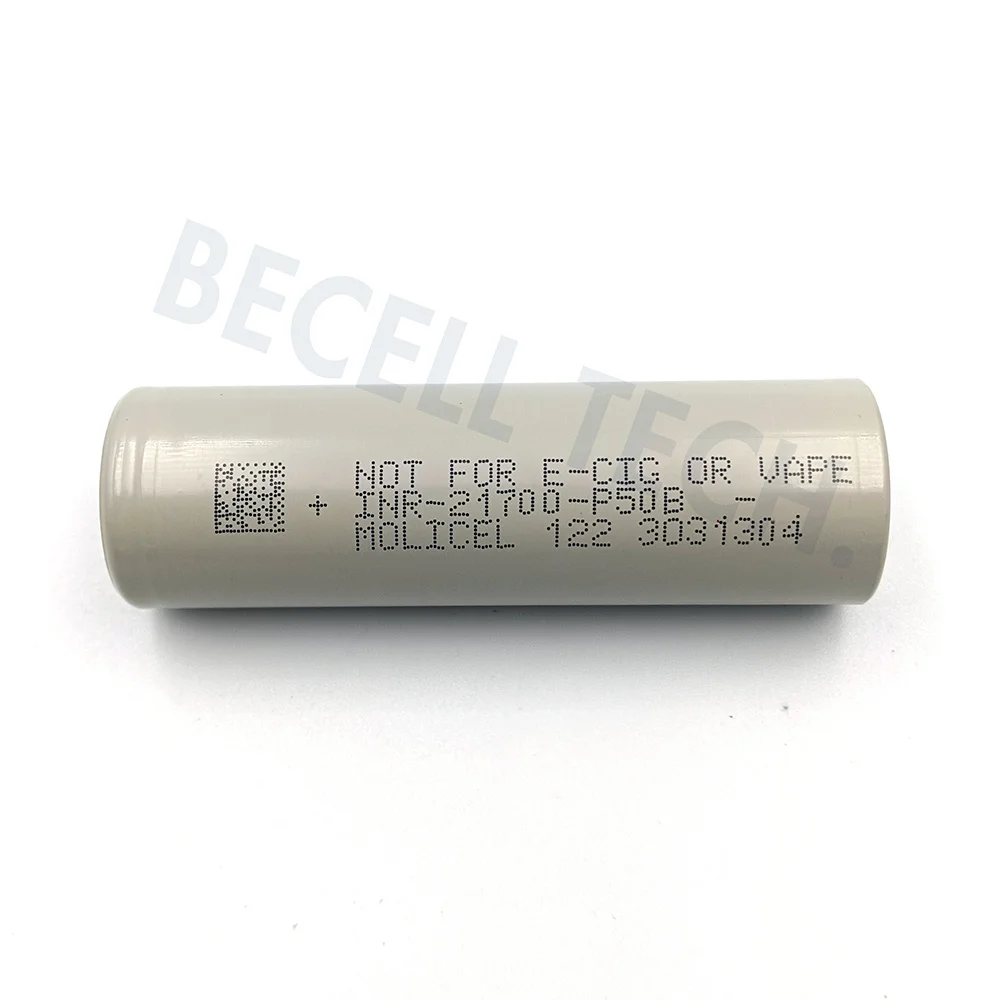
Who Needs 60A Discharge? Molicel P50B Deep Dive
Among 5000mAh-class 21700 cells, the Molicel P50B occupies a unique position.
The 50E competes on cycle life. The 50S competes on balance. The P50B competes on——extremes.
60A continuous discharge. 8mΩ internal resistance. -40℃ operating temperature. These three numbers define its user profile: not everyone needs the P50B. But those who do have almost no alternative.
This article won‘t walk through every spec. Instead, it focuses on one question: who should buy the P50B, and who shouldn’t?
Key Specifications at a Glance
| Parameter | Specification |
|---|---|
| Model | Molicel INR21700-P50B |
| Typical Capacity | 5,000mAh |
| Minimum Capacity | 4,850mAh |
| Continuous Discharge | 60A(80℃ thermal cutoff recommended) |
| Max Charge Current | 25A |
| Nominal Voltage | 3.6V |
| AC Impedance(at shipping) | ≤8mΩ |
| Weight | ≤70.0g |
| Dimensions | Φ21.40±0.15×70.00±0.15mm |
| Charge Temperature | -20~60℃ |
| Discharge Temperature | -40~60℃(ambient)/ -40~80℃(surface) |
| Cycle Life | ≥80% @ 500 cycles(5A discharge) |
| Warranty | 12 months |
Looking at the spec sheet, the P50B‘s “extremes” show up in three places: 60A discharge, 8mΩ impedance, and -40℃ operating temperature. These three numbers point to three distinct customer profiles.
60A Continuous Discharge: Who Actually Needs It?
Most devices don’t need 60A. E-bikes typically run between 15-35A. Power tools usually sit between 20-40A. Applications that actually need 60A fall into a few specific categories:
Racing drones. Takeoff requires massive current output with minimal weight. The P50B‘s 60A capability at 70g has almost no competition in this space.
High-power tools——large chainsaws, heavy-duty angle grinders. These tools demand sustained high current at full load, not just occasional bursts.
E-motorcycles and racing vehicles. These applications require both instantaneous burst power and sustained output.
If your customer isn’t in one of these three categories, the P50B is probably overkill. Not that it won‘t work——but the cost-to-benefit ratio doesn’t make sense. It‘s significantly more expensive than the 50S and far more than the 50E.
8mΩ Impedance: What It Actually Means in Practice
What does 8mΩ internal resistance mean in context? The 50S is at 14mΩ. The 50E is at 35mΩ. The P50B’s impedance is nearly half that of the 50S.
Lower impedance delivers two benefits: First, less heat generation and less energy loss at high current. Second, a flatter voltage curve——the device won‘t suddenly lose power at the end of the discharge cycle.
For drones, this means consistent power output right up to the last minute of flight. For power tools, it means the battery won’t hit thermal cutoff during heavy use.
But lower impedance comes at a cost——a more aggressive chemistry that can reduce cycle life. While the P50B still holds 80% after 500 cycles at 5A discharge, running it at 60A continuously will shorten its lifespan significantly.
-40℃ Operating Temperature: This Isn‘t Just a Nice-to-Have
Most 21700 cells have a -20℃ discharge temperature floor. The P50B goes down to -40℃.
For most customers, this spec will never matter. But for some, it’s the deciding factor.
If your customer is building e-bikes for the Nordic market, outdoor equipment for Canadian winters, or drones for high-altitude inspections——standard cells basically fail below -20℃. Capacity drops sharply, and internal resistance spikes. The P50B still delivers usable output at -30℃, delivering over 4Ah capacity. No other 5000mAh cell can match that.
The P50B Is Not an “Upgrade” Over the 50S
Many customers look at the P50B specs and ask:“Isn‘t this better than the 50S?” The answer is: it depends on what your device actually needs.
The 50S is the “good enough and safe” choice. Samsung brand, 5000mAh, 45A headroom, stable supply chain——perfect for most applications that need both capacity and power.
The P50B is the “extreme but expensive” choice. 60A, 8mΩ, -40℃——these specs are only worth the price when the device truly demands them.
If the device only needs 25A, the 50S is more than enough. Spending extra on the P50B won‘t deliver real value. But if the device needs sustained discharge above 40A, the P50B’s value becomes clear.
When to Recommend the P50B?
Before recommending it to a customer, ask three questions:
- What‘s the device’s sustained discharge current requirement? If it‘s above 40A, consider the P50B. If it’s 25-40A, the 50S can handle it.
- Does the device operate in sub-zero environments? If so, the P50B may be the only option.
- Does the customer care about brand? Samsung has stronger brand recognition than Molicel——some end customers specifically request Samsung.
Bottom Line
The P50B isn‘t for everyone. Its price, performance, and positioning all point to one conclusion: it serves a niche market with extreme requirements.
But for that niche, the P50B has almost no alternatives. 60A continuous discharge, 8mΩ impedance, -40℃ operating temperature——no other 5000mAh cell on the market currently delivers this combination.
BECELL has large stock of Molicel P50B. Contact us for samples and pricing.