
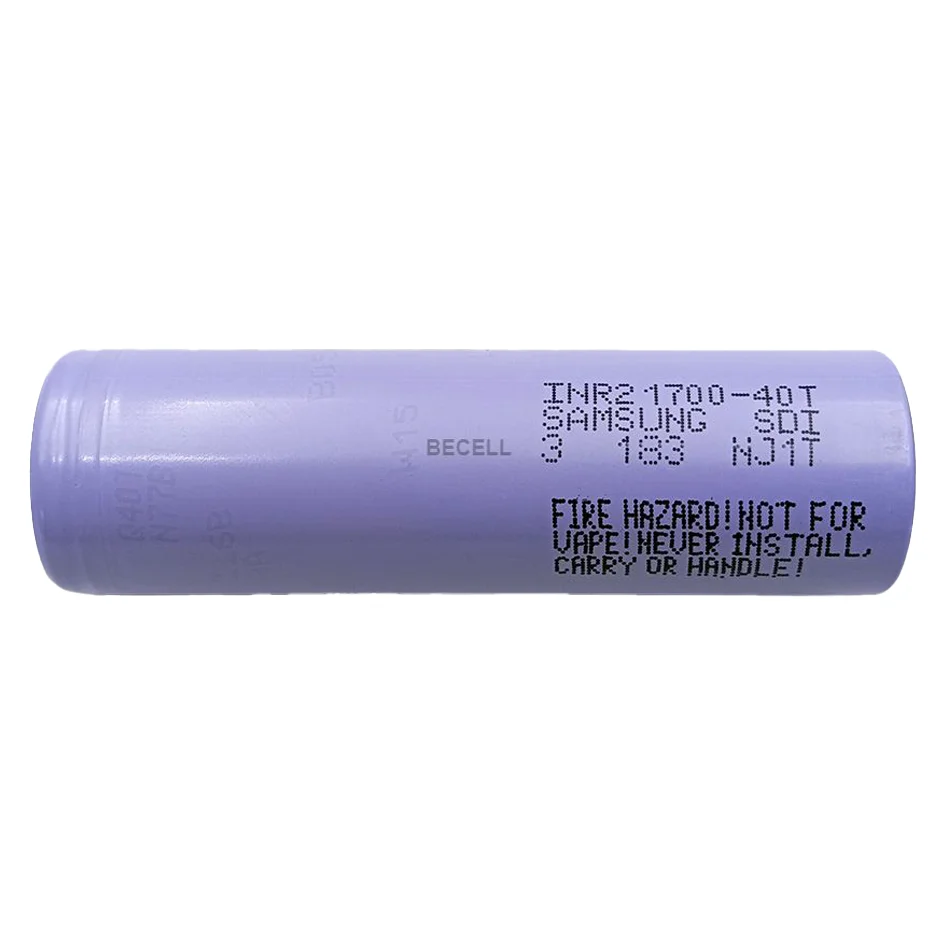
Samsung 40T Deep Dive:Why an 8-Year-Old 21700 Cell Still Hasn‘t Left the Market
The Samsung 40T 21700 battery was released in 2017. That’s nearly eight years on the market. By industry standards, that‘s several product lifecycles. Conventional logic suggests it should have been phased out by newer models. Yet the 40T still ranks among Samsung’s top three 21700 cells in monthly shipment volume.
Why does a cell with no standout specs continue to sell after eight years?
Core Positioning:Built for Power Tools
The 40T‘s specification sheet explicitly states its intended application on the first page——“for power tools.” This means the cell was never designed as a general-purpose product, but specifically optimized for power tool operating conditions.
Power tools typically operate in intermittent high-power mode: sustained discharge in the 30-35A range, with occasional transient loads above 40A. This use case translates to three basic cell requirements: stable sustained output, headroom for transient loads, and manageable weight and dimensions.
The 40T’s specifications align directly with these requirements: 35A continuous discharge, 45A with thermal cutoff, 4000mAh capacity, 70g weight. It wasn‘t designed for a capacity race, nor was it designed for extreme discharge applications. Its design objective was clear—provide a cost-effective, performance-stable solution within the power range that power tools actually use.
This positioning explains why the 40T’s specs look unremarkable on a general spec sheet, but are precisely matched to the power tool category.
35A and 45A:The Design Logic Behind the Two Numbers
The 40T spec sheet lists two discharge ratings: 35A(without temperature cutoff) and 45A(with 80℃ temperature cutoff).
35A is the normal operating current—the cell runs continuously at this level without extra thermal management. 45A is the headroom state—it requires thermal cutoff protection. The spec sheet also provides corresponding cycle life data: ≥60% capacity retention at 250 cycles under 35A discharge.
This combination reveals Samsung‘s design logic: set the normal operating current at 35A, leave 45A as a safety buffer, and clearly communicate the cost of using that buffer. This isn’t conservatism—it‘s clear boundary-setting for different use cases.
For customers whose devices run at around 35A continuously, the 40T is the right fit. For devices that occasionally spike above 40A, the 40T can handle it, but it’s not designed for sustained operation at that level.
12mΩ Impedance:Sufficient Without Overreaching
The 40T‘s AC impedance is 12mΩ. For reference: the 50S is 14mΩ, the P50B is 8mΩ. In the 4000mAh class, 12mΩ is above average.
Impedance directly determines heat generation at high discharge currents. For power tools that require sustained high-power output, thermal management affects two critical metrics: thermal protection trigger frequency and cycle life degradation rate. At 12mΩ, heat generation at 35A sustained discharge stays within manageable limits without requiring additional cooling design.
This impedance value also reflects the 40T’s design trade-offs. It doesn‘t push impedance to the extreme like the P50B(8mΩ), because extreme impedance often requires more aggressive chemistry that affects cycle life and cost. The 40T chooses a “sufficient” impedance value and relies on mature chemistry for stability and cost control.
The Assembly Advantage of 4000mAh
4000mAh offers an often-overlooked advantage in power tool battery pack design——clean multiples.
Common power tool battery pack capacities—4Ah, 8Ah, 12Ah—are all integer multiples of 4000mAh. With 5000mAh cells, 4Ah would require 0.8 parallel(not possible), 8Ah would require 1.6 parallel(not possible), and 12Ah would require 2.4 parallel(not possible). Actual assembly results in either excess capacity or mismatched specifications.
For customers building battery packs, assembly efficiency directly impacts BOM costs. The 4000mAh capacity has been validated through years of market use in the power tool category, forming a complete chain of design, manufacturing, and testing standards. The 40T’s continued volume in this category is partly attributable to the “standard” nature of its capacity.
Long Market Life:Three Factors Beyond Technology
A product can stay on the market for eight years based on more than its technical specs. The following three non-technical factors also play a role.
First, brand. Samsung‘s 21700 cells have some of the highest brand recognition in the end market. Customer requests to “spec Samsung” are common. The 40T is the lowest-cost cell in Samsung’s 21700 lineup—it meets brand requirements while minimizing BOM cost pressure.
Second, supply chain maturity. The 40T has been in production for years. Manufacturing processes are mature, capacity is stable, and batch consistency is high. For OEM projects requiring long-term supply, this matters more than cutting-edge specs.
Third, customer switching costs. Battery packs already designed around the 40T would require redesign, retesting, and recertification to switch to a different cell. These hidden costs often exceed the cell price difference.
Positioning Differences Between the 40T and P42A
Many customers compare the 40T against the Molicel P42A. From an application-matching perspective, their target customers actually don‘t overlap much.
The 40T serves the “Samsung brand required + 35A power requirement + cost-sensitive” customer segment. The P42A serves the “performance first + 45A sustained discharge + cycle life priority” segment. They overlap on paper but serve different project requirements.
For a detailed side-by-side breakdown, see our 40T vs P42A comparison guide.
Bottom Line
The 40T isn’t an exciting cell. Its specs are unremarkable, and it lacks obvious technological highlights. But it solves a very specific problem in the power tool segment——providing a brand-reliable, supply-stable, cost-effective standard solution within the 35A power range.
New specs arrive every year. But “good enough” never goes out of style—especially in categories where that’s exactly what customers need.