[Why Custom] [Spec Matrix] [How We Engineer] [Quality] [FAQ] [Request a Quote]
Custom 6S/12S Agricultural Drone Batteries — Built to Your Current, Size & Weight Targets
Most agricultural drone programs don’t fail because of a missing battery on the shelf — they fail because the shelf battery doesn’t fit the airframe, can’t sustain the spray pump’s current draw, or adds more grams than the payload budget allows.
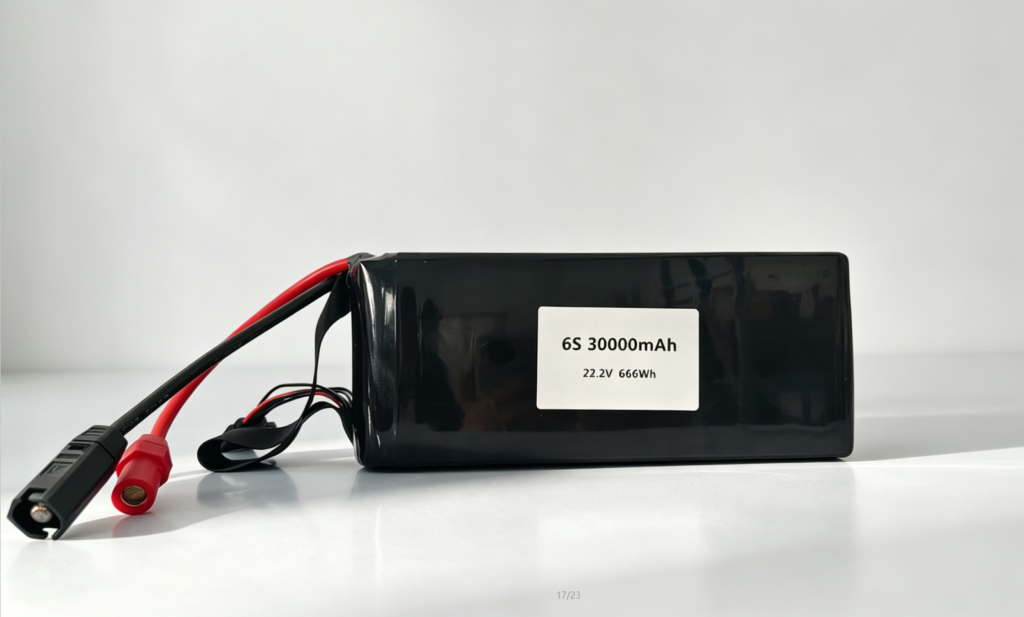
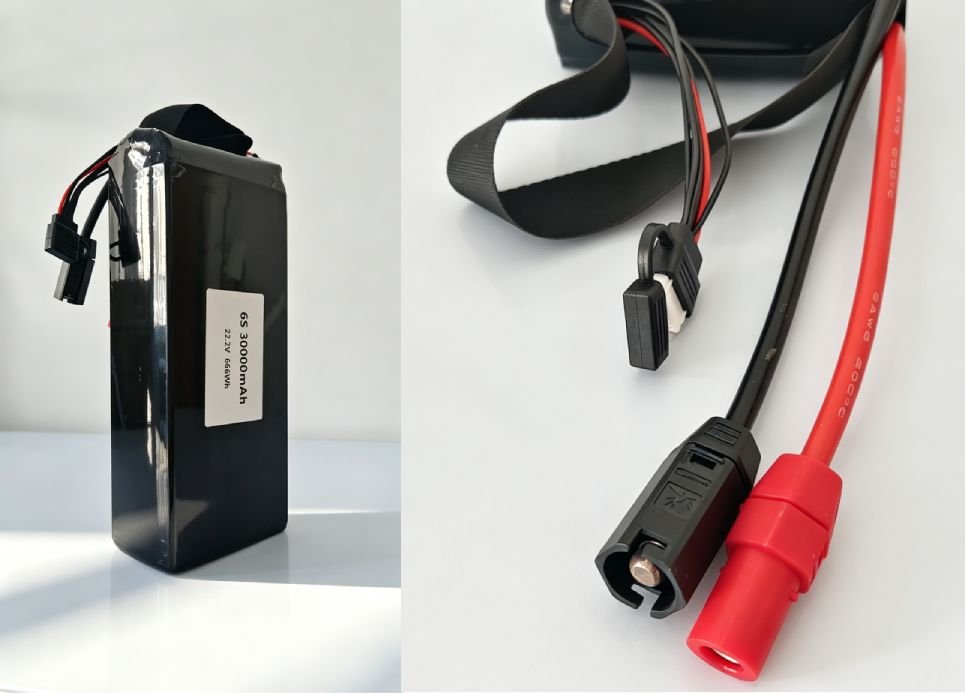
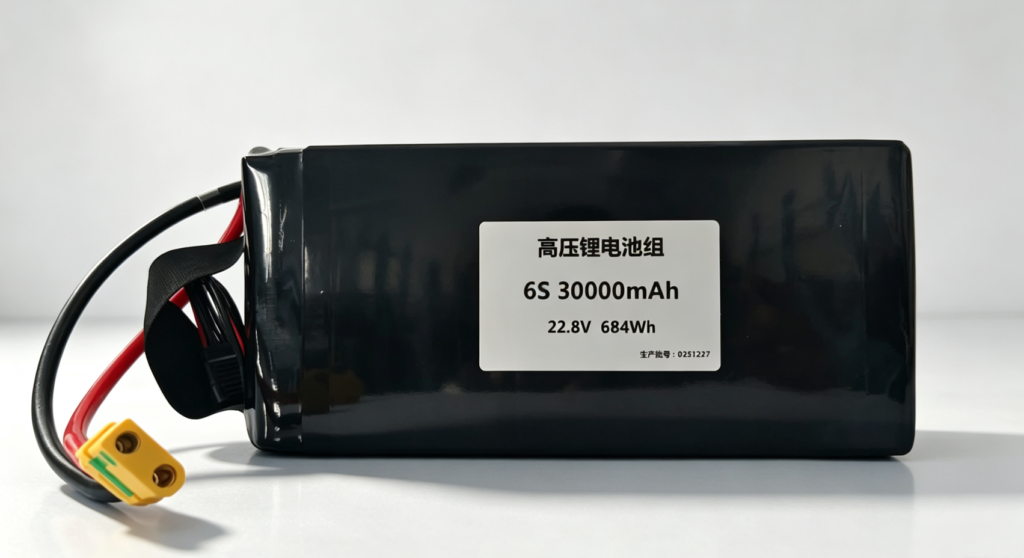
Becell builds custom agricultural drone battery packs around the three variables that actually decide whether a pack works in the field: discharge current, dimensions, and weight. The 6S and 12S configurations below are starting points — every pack can be re-engineered to your targets.
Why Agricultural Drone Batteries Can’t Be “Off-the-Shelf”
Current. Spray pumps and high-payload takeoff draw current spikes that a low-rate pack cannot sustain without voltage sag. The C-rate column in a datasheet is only useful if the continuous vs. peak definitions match your mission profile.
Size. Airframe battery bays are designed around structural hardpoints. A pack that is 5mm too thick may force a frame redesign — or a lower-capacity pack that shortens the spray window.
Weight. Every gram of battery is a gram of payload or flight time. At the 30–36Ah end of the matrix, two packs with the same nominal capacity can differ by several hundred grams depending on the rate/energy-density trade-off.
Duty cycle. Field operations demand repeated charge–discharge cycles under heat and vibration. A pack rated only for “lab C-rate” without cycle-life validation is a field-replacement risk, not a power solution.
6S / 12S Spec Matrix — Starting Points, Not Fixed Catalogue
| Config | Capacity | Dimensions (mm) | Weight | C-rate (cont./peak) | Energy Density | Voltage |
|---|---|---|---|---|---|---|
| 6S | 12Ah | 185×73×48 | 1,460g | 2C / 25C | 205 Wh/kg | 22.2V |
| 6S | 16Ah | 185×73×64 | 1,850g | 5C / 25C | 220 Wh/kg | 22.8V |
| 6S | 22Ah | 202×88×58 | 2,380g | 2C / 25C | 235 Wh/kg | 22.8V |
| 6S | 30Ah | 245×106×62 | 3,670g | 6C / 25C | 205 Wh/kg | 22.8V |
| 6S | 36Ah | 245×106×59 | 3,500g | 3C / 20C | 265 Wh/kg | 22.8V |
| 12S | 16Ah | 190×74×128 | 3,700g | 5C / 25C | 220 Wh/kg | 45.6V |
| 12S | 22Ah | 207×89×116 | 4,760g | 2C / 25C | 235 Wh/kg | 45.6V |
| 12S | 30Ah | 250×107×111 | 6,400g | 5C / 25C | 240 Wh/kg | 45.6V |
| 12S | 36Ah | 250×107×117 | 6,870g | 3C / 20C | 265 Wh/kg | 45.6V |
C-rate shown as continuous / peak. Energy density values reflect cell-level or pack-level measurement basis; confirm the basis for your procurement comparison. Dimensions and weight are for the reference configuration; tolerances and connector/BMS integration change final values. The full matrix covers 6S/12S from 12Ah to 36Ah, plus additional rate variants.
How We Engineer Around Your Three Variables
1. Current-first cell & tab selection.
We start from your continuous and peak current profile, not from a cell that happens to be in stock. For agricultural spray and lift profiles, the pack is configured around the discharge rate the mission actually demands. Our engineering scope extends to 5C+ continuous discharge configurations and higher-rate pack architectures where the airframe requires it.
2. Dimensional co-design against the airframe bay.
You provide the internal bay envelope, mounting points, and connector orientation. We return a pack layout with dimensions, weight estimate, and connector/BMS placement for fit confirmation before tooling. The reference dimensions above are not limits — they are calibration points.
3. Weight budget as a design constraint, not an output.
If your target is flight time, we optimize toward higher energy density. If your target is current headroom, we accept a rate-driven weight penalty. You set the priority; we quantify the trade-off before you commit.
4. Voltage platform flexibility.
Choose 22.2V/44.4V for standard platforms, or 22.8V/45.6V for higher-voltage architectures. For programs pushing beyond 12S, our customization scope extends to higher-series configurations and larger per-cell capacities.
5. Semi-solid-state and high-energy-density options.
Where weight is the dominant constraint, our engineering team can evaluate semi-solid-state architectures with cell-level energy density up to 320Wh/kg, subject to cycle-life and rate requirements.
Quality & Compliance for Field Deployment
Each custom pack is validated against the agreed specification: voltage, impedance, capacity, and cycle-life checkpoints before shipment. Documentation support includes UN38.3, CE, RoHS, and ISO-aligned manufacturing processes. For programs requiring extended cycle-life validation, we define the test protocol together during the prototyping phase rather than relying on a generic datasheet number.
Frequently Asked Questions
Q: Can you build a 6S or 12S pack outside the dimensions in the matrix?
Yes. The matrix is a reference set. Send the bay envelope, mounting constraints, and connector orientation; we return a dimensional proposal for confirmation.
Q: What does “2C/10C/25C” mean on your reference packs?
The three figures are continuous / peak / burst-class references. Because the industry does not use a single standardized definition, we confirm the exact continuous and peak current for your mission profile in the specification document before production.
Q: Can you match a specific discharge current instead of a C-rate label?
Yes. Provide the continuous current (A) and peak current/duration (A for X seconds). We configure the cell, tab, and BMS accordingly.
Q: What is the minimum order for a custom configuration?
Prototype and sample quantities are accepted for engineering validation. Production volume is quoted after the specification is frozen. Use the quote form to describe your program stage.
Q: Do you support 12S packs above 36Ah?
The reference matrix covers up to 36Ah at 6S/12S. Higher-capacity and higher-voltage configurations are within our customization scope; share the target capacity, voltage, and current profile for a feasibility review.
Request a Spec Review
- Voltage platform (6S / 12S / other)
- Target capacity (Ah)
- Continuous current (A) and peak current / duration
- Max dimensions (L×W×H mm) or airframe bay envelope
- Weight target (g) or priority (flight time vs. current headroom)
- Application (spraying / seeding / lifting / other)
- Program stage (prototype / field trial / production)
- Work email
Send Requirements for Engineering Review
Store: www.becell0101.com