
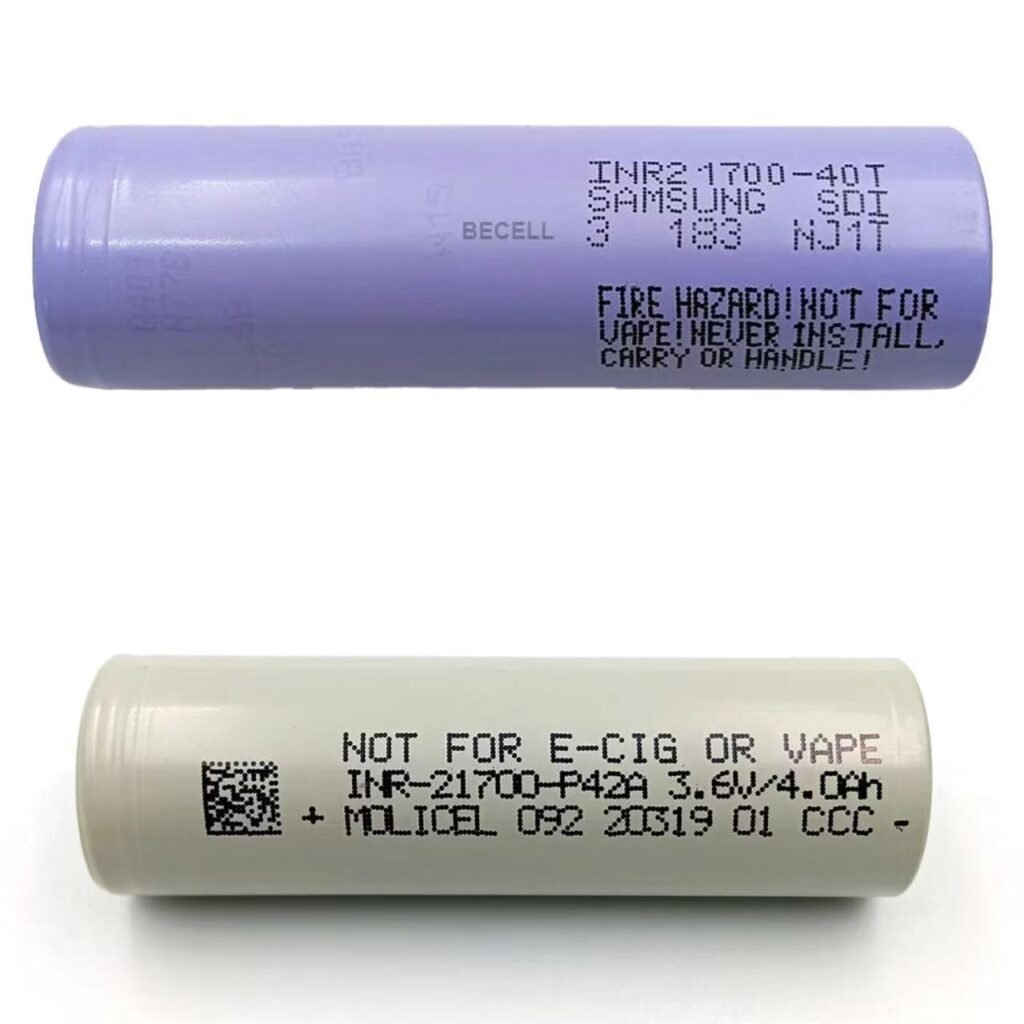
“Samsung 40T vs Molicel P42A —— it’s one of the most common comparisons in the 21700 high-rate cell market, and every battery wholesaler has to make this call sooner or later. Customers ask all the time:‘What‘s the difference? Which one should I stock?’”
On paper, they look very similar – both have a minimum capacity of 4,000mAh, both handle up to 45A discharge, and they’re nearly identical in size and weight. But look closer, and you‘ll notice the P42A has a typical capacity of 4,200mAh – giving you an extra 200mAh of real-world runtime compared to the 40T.
This isn’t a spec sheet. This is a practical breakdown for buyers who need to make the right call – whether you‘re stocking inventory, building battery packs, or supplying an OEM production line.
Two Cells, Two Different Philosophies
The Samsung 40T was designed for one thing:dependability. It‘s the battery you spec when you need a solid, brand-name solution that works across a wide range of power tools and general-purpose devices. It delivers 35A continuous (45A with temperature cutoff), which covers the majority of high-power applications out there.
More importantly, it carries the Samsung name. When your customer says “I want Samsung,” the 40T is what they mean. That brand recognition matters – especially in markets where end-users trust the logo on the label.
The Molicel P42A, on the other hand, was built for performance. With a typical capacity of 4,200mAh (200mAh more than the 40T), 45A continuous right out of the gate (no temperature cutoff needed), and significantly better cycle life. It’s not for the “good enough” crowd. It‘s for applications that demand every bit of runtime and burst power you can get.
The Numbers That Actually Matter
Let’s cut through the marketing and look at what really matters for a wholesale buyer.
| What Matters | Samsung 40T | Molicel P42A |
|---|---|---|
| Typical Capacity | — | 4,200mAh |
| Minimum Capacity | 4,000mAh | 4,000mAh |
| Continuous Discharge | 35A (45A w/ temp cut) | 45A (no temp cut needed) |
| Cycle Life | 60% @ 250 cycles | 80% @ 500 cycles |
| AC Impedance | ≤12mΩ | ≤15mΩ |
| Charge Temp Range | 0~45℃ | 0~60℃ |
| Discharge Temp Range | -20~60℃ | -40~60℃ |
| Warranty | 15 months | 12 months |
Here‘s what those numbers actually mean in practice.
Cycle Life:The Real Cost Driver
If your customers are in drone leasing, shared e-bikes, or any business where batteries cycle daily, this is where the P42A separates itself.
- The Samsung 40T hits 60% capacity after 250 cycles. At that point, it’s time to replace.
- The Molicel P42A still holds 80% after 500 cycles – and that‘s at 10A discharge.
Run the numbers. The P42A costs a bit more upfront, but it lasts nearly twice as long. For high-usage applications, the total cost of ownership is actually lower. If your customer is replacing batteries every year with the 40T, they’d be replacing them every two years with the P42A. That adds up fast.
For light-use applications – think DIY tools or occasional equipment – the 40T is the better financial move. Lower upfront cost, and the cycle life difference won‘t matter as much.
Low Impedance Isn’t Always the Winning Card
The 40T has 12mΩ impedance. The P42A has 15mΩ. On paper, the 40T wins. Lower impedance means less heat, better efficiency.
But here‘s what the spec sheet doesn’t tell you:these numbers are measured differently. The 40T‘s 12mΩ is measured after standard charge. The P42A’s 15mΩ is its “first-cycle” value. In actual high-current use, the real-world difference is negligible.
More importantly, the P42A‘s slightly higher impedance is the trade-off for higher capacity and dramatically better cycle life. That’s a trade I‘d take every time.
Cold Performance:P42A Is the Only Option
If your customer’s equipment operates below freezing – e-bikes in northern Europe, outdoor drones in Canada, cold-chain logistics – this decision is already made.
- Samsung 40T stops at -20℃
- Molicel P42A keeps going down to -40℃
Below -20℃, the 40T‘s capacity drops sharply. The P42A, on the other hand, still delivers usable power. For customers serving cold markets, the P42A isn’t a “nice to have.” It‘s the only viable choice.
So Here‘s How I Help Customers Decide
This is the framework I use with every buyer:
Choose the Samsung 40T if:
- You’re building standard power tools, vacuums, or garden equipment
- Your customer explicitly requests Samsung
- Discharge current stays under 35A – you don‘t need extreme output
- Budget is a primary concern – you want the best price per cell
- Usage frequency is moderate – cycle life isn’t a critical factor
Choose the Molicel P42A if:
- You‘re building racing drones, high-end tools, or e-motorcycles
- Every extra minute of runtime matters
- Equipment operates in freezing environments
- Batteries are used daily – long life reduces long-term costs
- Your customer prioritizes performance over brand name
The Bottom Line for Wholesale Buyers
There is no “better” cell. There’s only the cell that fits your customer‘s application.
What I tell every buyer is this:get the specs right, but don’t stop there. Ask about real use. How often does the device run? What‘s the environment? What’s the customer‘s real priority – upfront cost or long-term reliability?
That’s where the answer lives. Not on a spec sheet.
Both of these cells are top-tier products. Both are in stock at BECELL, ready for shipment. The right one depends entirely on what you‘re building.
Need samples? Have a specific application in mind? Let’s talk. We‘ve been doing this long enough to know there’s no one-size-fits-all answer – but there‘s always a right one for you.