
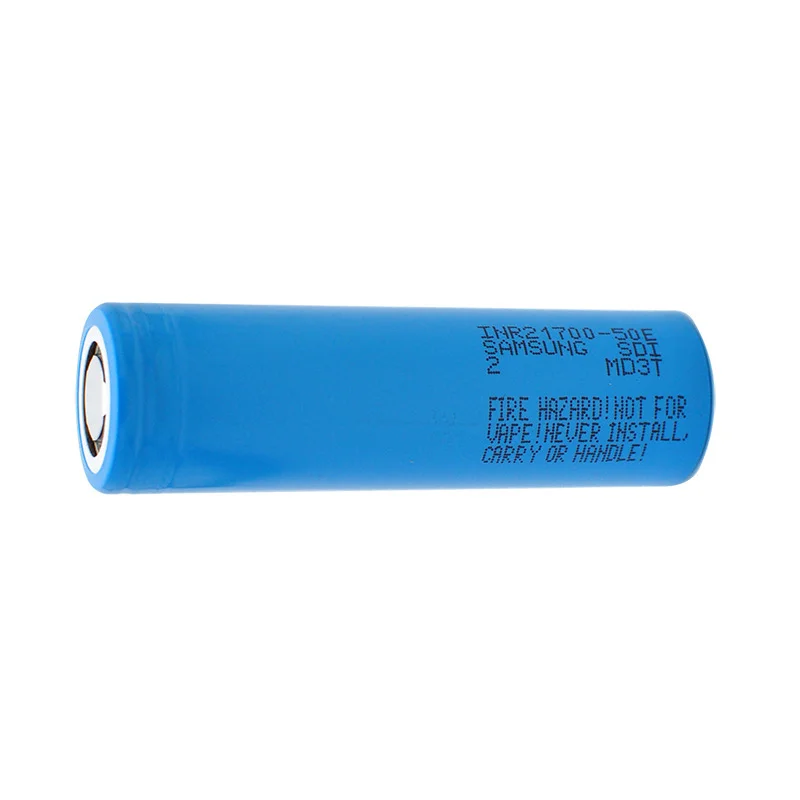
Samsung 50E Deep Dive:Why This 7-Year-Old 21700 Cell Is Still a Top Seller
In the Samsung 21700 battery lineup, the 50E is something of an outlier. It doesn‘t boast 45A discharge like the 50S, nor does it chase 60A extreme output like the Molicel P50B. On paper, its specs even look modest—9.8A continuous discharge, which seems unimpressive in a market where high-rate cells routinely start at 30A. Nevertheless, this “modest” cell has been on the market since 2017—seven years and still going strong. In fact, it remains one of the most popular choices in energy storage systems and e-bike applications. For this reason, it’s worth taking a closer look at what makes it tick.
So what exactly is the 50E?
Let‘s start with the fundamentals:
| Parameter | Specification |
|---|---|
| Model | Samsung INR21700-50E |
| Standard Capacity | Min. 4,900mAh |
| Rated Capacity | Min. 4,753mAh(at 1C discharge) |
| Continuous Discharge | 9.8A(continuous)/ 14.7A(non-continuous) |
| Max Charge Current | 4.9A |
| Nominal Voltage | 3.6V |
| AC Impedance | ≤35mΩ |
| Weight | ≤69g |
| Dimensions | ≤Φ21.25×70.80mm |
| Cycle Life | ≥3,802mAh @ 500 cycles(80% of rated capacity) |
| Charge Temperature | 0~45℃ |
| Discharge Temperature | -20~60℃ |
| Warranty | 15 months |
At first glance, the 50E’s discharge capability does look modest. However, this cell‘s real value has never been about “how much current can it push.” Instead, its strength lies somewhere else entirely.
The 50E‘s True Strength:Cycle Life
Here’s a number in the spec sheet that‘s easy to overlook—but it’s exactly what makes the 50E so valuable:
After 500 cycles, capacity remains above 80% of rated capacity.
To put that in perspective: 80% of 4,753mAh is 3,802mAh. Many cells drop to that level after just 200 cycles. The 50E, on the other hand, holds that line all the way to 500 cycles.
What does this mean in practice? If your customer is building home energy storage, portable power stations, or commuter e-bikes that cycle daily, the 50E will run for over a year and a half with capacity degradation still under 20%. With a lesser cell, they‘d see noticeable range loss in just six months. For this reason, the 50E delivers fewer replacements and lower long-term costs—which, for many customers, matters more than peak discharge numbers.
On Capacity:Samsung Plays It Straight
The 50E’s standard capacity is 4,900mAh, with a rated capacity(under 1C discharge) of 4,753mAh. That‘s not the highest number in the 5000mAh class. Nevertheless, Samsung’s numbers are honest—the gap between standard and rated is only about 3%, meaning even at 1C discharge, capacity loss is minimal.
Some brands claim 5,000mAh but struggle to hit 4,800 at 1C. The 50E‘s advantage is simple: what’s on the spec sheet is what the customer gets. In addition, this honesty translates to fewer complaints and fewer returns—a significant benefit for B2B wholesalers.
Higher Internal Resistance—Flaw or Trade-Off?
The 50E‘s internal resistance is ≤35mΩ, significantly higher than the 50S’s 14mΩ or the P50B‘s 8mΩ. At first glance, that looks like a disadvantage.
However, there‘s a reason for that higher resistance. The 50E was designed for high capacity, long life, and low-rate discharge—not high-current output. Its chemistry is optimized for long-term stability at low C-rates, not burst power. In other words, this is a cell built for “steady use,” not “hard use.” In an energy storage system that cycles once a day at under 5A, the 50E will run for years. On the other hand, if a customer tries to use it in an angle grinder or chainsaw that demands instant high current, they’re using the wrong tool for the job.
Who Is the 50E For? Who Is It Not For?
Good for:
- Home energy storage systems(daily cycling, long-term stability)
- Portable power stations(low discharge, long runtime)
- Commuter e-bikes(moderate current draw, cycle life matters)
- LED lighting, surveillance equipment, and other low-power applications
- OEM bulk orders where cost sensitivity is high
Not good for:
- High-power tools(angle grinders, chainsaws)
- Racing drones
- E-motorcycles
- Any application requiring sustained discharge above 10A
Many customers pick the wrong cell not because they bought a fake, but because they chose the right cell for the wrong application. The 50E isn‘t the problem—it’s being used where it doesn‘t belong. For this reason, helping customers match the cell to the application is one of the most valuable things a wholesaler can do.
How Does It Compare to the 50S?
This is the most common question we get. Here’s the quick breakdown:
| Comparison | 50E | 50S |
|---|---|---|
| Capacity | 4,900mAh | 5,000mAh(Typ.) |
| Discharge | 9.8A | 25A(no temp cut)/ 45A(with temp cut) |
| Impedance | ≤35mΩ | ≤14mΩ |
| Cycle Life | ≥80% @ 500 cycles | ≥60% @ 250 cycles |
| Price | Lower | Higher |
The 50E‘s advantage isn’t in specs—it‘s in the P&L. It costs less, lasts longer, and for applications that don’t need high current, the value proposition is obvious. Conversely, the 50S is for those who need both capacity and power. The right choice depends entirely on the customer‘s application.
A Word for Wholesale Buyers
The 50E is an honest cell. Its specs won’t blow anyone away—but they also don‘t overpromise. Samsung’s positioning for this cell is clear: a long-life solution for energy storage and low-power applications.
Your real value as a wholesaler is helping customers match the cell to the application. If you can clearly explain what the 50E is good for—and what it‘s not—your customers will trust you. Furthermore, they won’t shop around just to save a few cents.
This cell may not have the fattest margin. Nevertheless, it delivers repeat orders. Customers in energy storage and e-bikes, once they get used to the 50E‘s reliability, rarely switch models. For them, stability and lifespan matter more than eye-catching numbers.
BECELL stocks Samsung 50E in large quantities. Contact us for samples and pricing.