
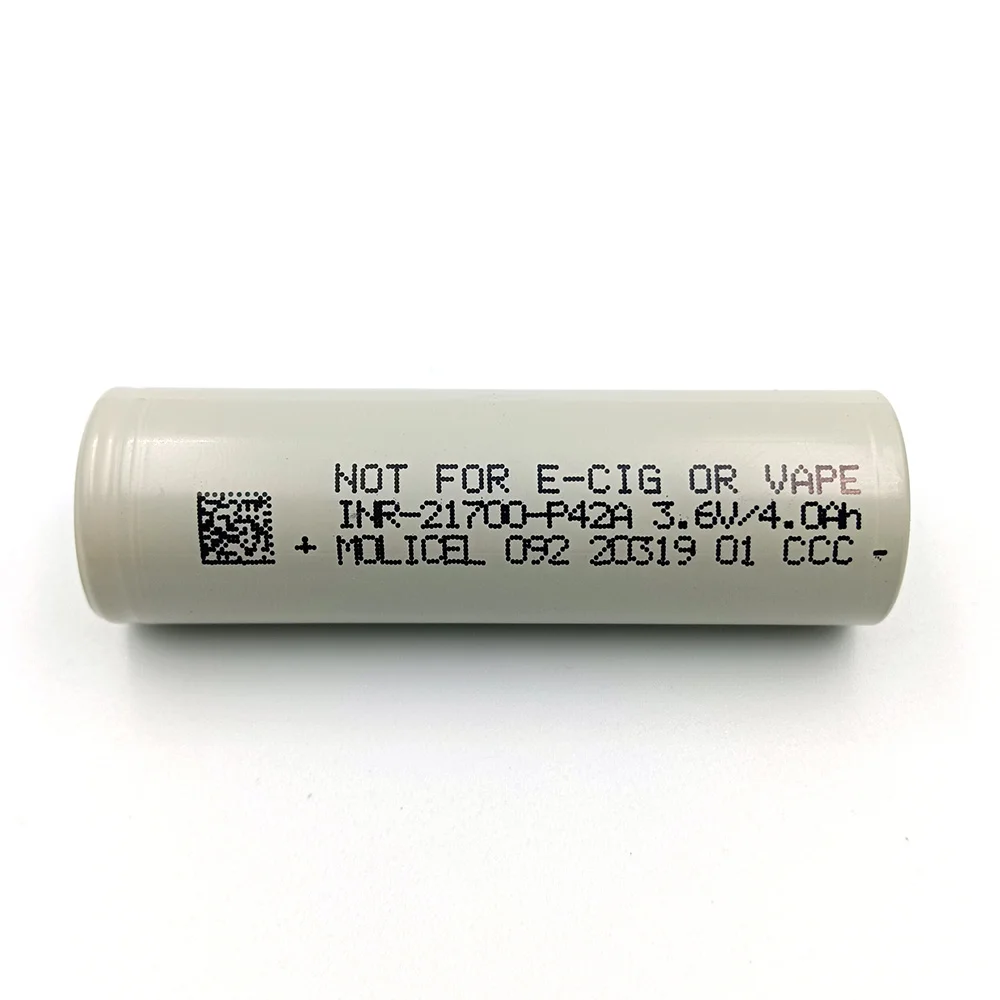
The Performance-First Choice:Is Molicel P42A Worth the Extra Cost?
I often encounter this scenario when customers are sourcing batteries: they have a quote for the Samsung 40T, and they ask——Molicel INR21700 P42A costs more. Where does the extra cost go?
It‘s a fair question. Both the Molicel P42A 21700 battery and the Samsung 40T are high-rate cells. Both go into power tools and drones. One is 4000mAh, the other is 4200mAh——they don’t look that different on paper. But customers who‘ve actually tested both will tell you they’re not the same kind of product at all.
The 40T’s philosophy is “good enough”——meet the power requirement, keep the cost low. The P42A‘s philosophy is “give as much as possible”——more capacity, stronger discharge, better cycle life, superior cold performance. The trade-off is higher unit cost.
Is it worth it? It depends on what your customer actually needs.
Key Specifications
| Parameter | Specification |
|---|---|
| Model | Molicel INR21700-P42A |
| Typical Capacity | 4,200mAh |
| Minimum Capacity | 4,000mAh |
| Continuous Discharge | 45A |
| Max Charge Current | 8.4A |
| Nominal Voltage | 3.6V |
| AC Impedance | ≤15mΩ |
| Weight | ≤70.0g |
| Charge Temperature | 0~60℃ |
| Discharge Temperature | -40~60℃ |
| Cycle Life | ≥80% @ 500 cycles(4.2A) ≥80% @ 500 cycles(10A) |
| Warranty | 12 months |
Side by side with the 40T, the differences are clear: 200mAh more capacity(typical), 10A higher continuous discharge, and more than double the cycle life——80% capacity retention after 500 cycles, versus the 40T’s 60% at 250 cycles.
The trade-off is also clear: higher cost. If you‘ve been tracking market prices for these two cells, you know the gap is large enough to steer cost-sensitive projects straight to the 40T.
What Does 45A Continuous Discharge Actually Mean?
The P42A’s 45A rating is continuous discharge without temperature cutoff. By contrast, the 40T‘s 45A requires 80℃ thermal cutoff to work, with its normal sustained rate sitting at 35A.
This means if your customer’s device needs sustained output in the 35-45A range, the P42A is the more comfortable choice. No need for extra thermal management strategies to prevent overheat protection from kicking in. In practice, that translates to a flatter voltage curve under extreme conditions——the device won‘t shut down unexpectedly because the battery voltage dropped too far.
Specifically: in high-power tools or racing drones that draw 38-42A continuously, the 40T is approaching its daily upper limit, while the P42A is still in its comfort zone. The Molicel P42A 21700 battery delivers 45A as its everyday use current. The 40T‘s 45A is occasional headroom.
Cycle Life:The P42A’s Strongest Card
The **Molicel P42A 21700 battery** offers impressive cycle life numbers.——≥80% capacity retention after 500 cycles at both 4.2A and 10A discharge.
Compare that to the 40T’s 60% at 250 cycles. The gap is more than double.
What does that mean in practice? If your customer‘s equipment runs daily——every day, charge and discharge——the P42A’s replacement cycle could be twice as long as the 40T‘s. Higher unit cost, yes. But the cost per cycle is actually lower.
For businesses where “cycles are money”——battery leasing, shared e-bikes, drone inspection fleets——cycle life is one of the most important procurement metrics. The P42A’s advantage in this dimension easily outweighs its price premium.
-40℃ Discharge Capability:More Practical Than You Might Think
The P42A‘s spec sheet lists -40℃ as the lower discharge temperature limit. Most customers will never need this. But when you do need it, there’s no alternative.
The 40T‘s lower discharge limit is -20℃. Below -20℃, its capacity drops sharply and internal resistance spikes. The P42A still delivers over 3.3Ah at -30℃ under 4.2A discharge.
If your customer is building e-bikes for the Nordic market, outdoor equipment for Canadian winters, or drone inspection systems for high-altitude operations, this capability could be the deciding factor. Users in those markets are used to “winter range loss”——but the P42A makes that loss smaller.
How to Choose Between the P42A and the 40T?
This is the core procurement decision. Consider three dimensions:
Continuous current requirements. If the device runs below 35A, the 40T is sufficient. If sustained current sits in the 35-45A range, the P42A is the better match.
Usage frequency and cycle life requirements. If your customer needs 500+ cycles, the Molicel P42A 21700 battery is the better match. If usage is light, the 40T‘s cycle life is adequate.
Operating temperature. If the device operates below -20℃, the P42A is effectively the only choice.
In short: the 40T solves the “good enough” problem. The P42A solves the “better” problem. If your customer is willing to pay for “better,” the P42A is worth a serious look.
Bottom Line
The Molicel P42A 21700 battery does cost more than the Samsung 40T, but its value is clear. But its value shows up in three specific areas: 45A continuous discharge without thermal cutoff, more than double the cycle life, and -40℃ discharge capability that’s nearly unique in this class.
It‘s ideal for customers with higher power demands, higher usage frequency, or colder operating environments. If your customer doesn’t fall into any of these three categories, the 40T is the more cost-effective choice. If they do, the P42A is the right call.